


William Talman (pictured above left) was born in Wiltshire on 12 January 1650 as the second son of a gentleman farmer. Little is known of his early life and architectural training, other than that he inherited the lease of three houses in King Street, Westminster following his father’s death.
His first major commission is generally considered to be Thoresby Hall, Nottinghamshire (pictured below), though this is debated. There is much confusion over the project – in his major work, Vitruvius Britannicus, Colen Campbell gives the date for the project as 1671, which would make Talman only 21 years old, a remarkable feat if it were true. Present thinking is that the house was commissioned by the 4th Earl of Kingston-Upon-Hull, who inherited the house in 1682, putting construction in the early 1680s.

If it was Talman's first design, it was a revolutionary one, which served to usher in a new style of building. In particular, Thorseby was the first house to introduce the idea of a flat roof with balustrade as well as decorative elements more commonly seen on Italian Baroque palaces such as the Palazzo Farnese. Talman’s house burnt down in 1746, and nothing of it remains today.
Talman was first engaged by the 1st Duke of Devonshire at Chatsworth in 1685/6, likely as a result of his work at Thoresby.
Talman was certainly not the most famous architect working in England at this date - that mantle surely rested with Sir Christopher Wren, Surveyor of the King's Works. However, Wren was occupied by projects for the King during the 1680s and had little time for private commissions. So, despite Talman lacking a national reputation at this date, the reception of Thoresby was likely enough to recommend him to the Duke.
Talman is responsible for remodelling the south and east fronts at Chatsworth, and first appears in the accounts between December and January 1687. He worked with the Duke for nearly a decade; his last visit to Chatsworth was in midsummer 1696, for which he was paid £50 for his journey.
His design for the South Front (pictured below) at Chatsworth was inspired and made the most of the architectural difficulties created by the preservation of the bulk of Bess of Hardwick's Elizabethan house.
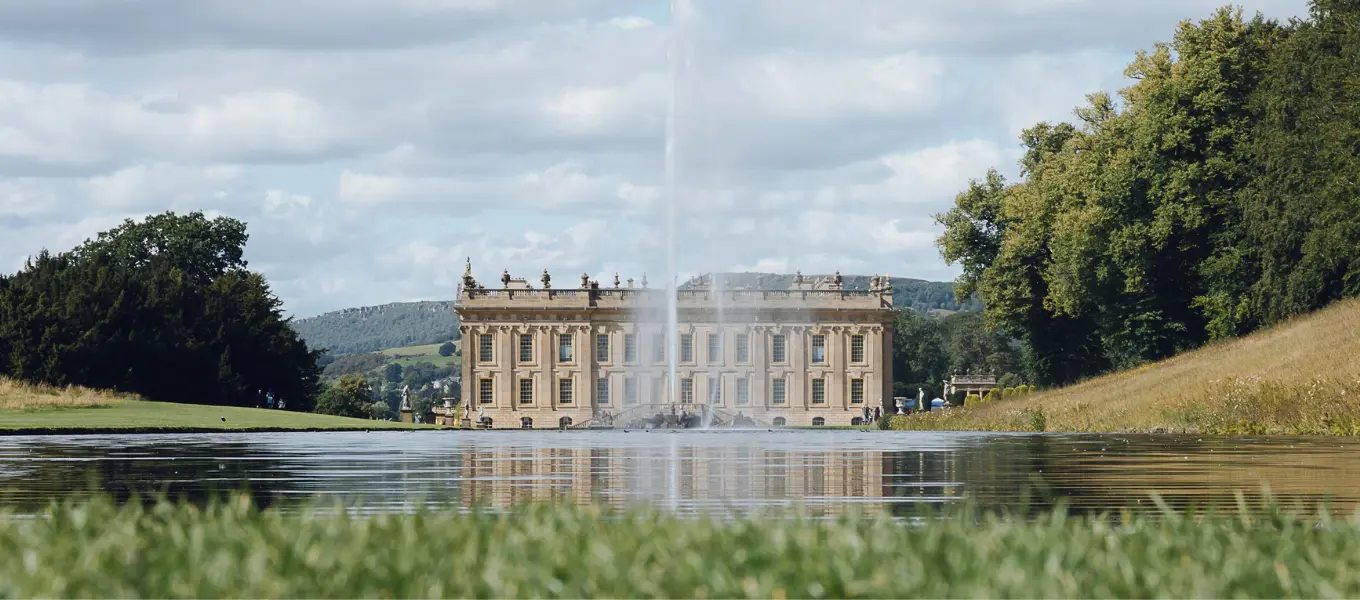
With only one State Apartment, the two most important rooms fell at either end of the façade, creating a lack of central focus. Talman solved this dilemma by articulating the more important rooms with giant order pilasters, and recessing the comparably less important spaces. His design bears close similarities to those produced by Bernini for the Louvre in the 1660s.
While employed at Chatsworth, Talman was appointed as Comptroller of the Royal Works, working under Christopher Wren. Talman primarily worked on the scheme to remodel Hampton Court Palace, with particular regard to the interiors of the new state rooms. He also worked on a series of other country house projects, including Dyrham Park, Kiveton Park (demolished in 1812), and Drayton House, as well as submitting plans for Cannons House, Welbeck Abbey and Castle Howard.
In the early years of the 18th century, however, Talman came to be eclipsed by John Vanbrugh as the country house architect of choice; he was also replaced by Vanbrugh as Comptroller of the Royal Works. This was partly due to style, but also to character, as Talman had gained a reputation for being difficult to work with.
Following a building collapse at Hampton Court in 1689, he had tried to apportion the blame wholly to Wren, in an attempt to supplant the latter as Surveyor of the King's Works. He was dismissed from the project to rebuild Welbeck Abbey following a dispute with the Duke of Newcastle; filed a lawsuit against the Earl of Carlisle for what he considered insufficient payment for his work on the Castle Howard designs; and he presented a petition to the 2nd Duke of Devonshire in 1708 claiming for payments which had been missed by the 1st Duke. He also unsuccessfully attempted to be reappointed to the post of Comptroller of the Royal Works in 1713, claiming he was owed £600 in wages.
Despite this loss of income in the latter years of his life, he was still able to purchase the manor of Felmingham in Norfolk. He was also a major collector of drawings and other architectural treatises, describing his library in 1713 as ‘the most valuable collection of books, prints, drawings etc as is in any one person’s hands in Europe’.
He collected many of the drawings of Inigo Jones and John Webb, as well as purchasing the former’s collection of drawings by Palladio. These were inherited by his son, who in turn sold them to the 3rd Earl of Burlington; they would subsequently end up at Chatsworth, via Charlotte Boyle, wife to the 4th Duke of Devonshire, and Burlington’s heiress.
Talman died on 22 November 1719 and is buried in St Andrew's Churchyard in Felmingham, Norfolk. His wife, Hannah (nee Piggott), survived him by 10 years and is buried in the same churchyard.
Continue reading
Header and main image above:
William Talman (left) with his son John Talman, his daughter-in-law Frances, and his wife Hannah.
The Talman Family Group by Giuseppe Grisoni, oil on canvas, 1718-1719, NPG 5781
© National Portrait Gallery, London
https://creativecommons.org/licenses/by-nc-nd/3.0/
Image of Thoresby Hall courtesy of Warner Hotels.